June 6, 2026 | TRAVEL
NOBU TORONTO DRAWS from the JAPANESE RYOKAN
words YUZU Editorial
photos Ema Peter Photography
production Karine Monié
High above Toronto’s Entertainment District, Canada’s first Nobu Hotel brings a quieter approach to hospitality. Inspired by the atmosphere of a Japanese ryokan, the project favours calm, ritual, and material clarity over spectacle.


Designed by Studio Munge under the direction of Alessandro Munge, the hotel occupies the upper levels of a new mixed-use development built on the site of a former Canadian glass manufacturing facility. Fragments of that industrial history remain throughout the project. Original glass blocks have been preserved and incorporated into the fitness area, while the retained street façade maintains a connection with the neighbourhood’s architectural memory.
Above it, two slender residential towers rise around a central void that cuts through the structure between the ninth and tenth floors, drawing daylight deep into the building. The opening becomes one of the project’s defining features. From the gym, guests can watch snowfall or rain descend through the space above, while rooms higher up look down into the illuminated core below.
BETWEEN CITY AND SANCTUARY
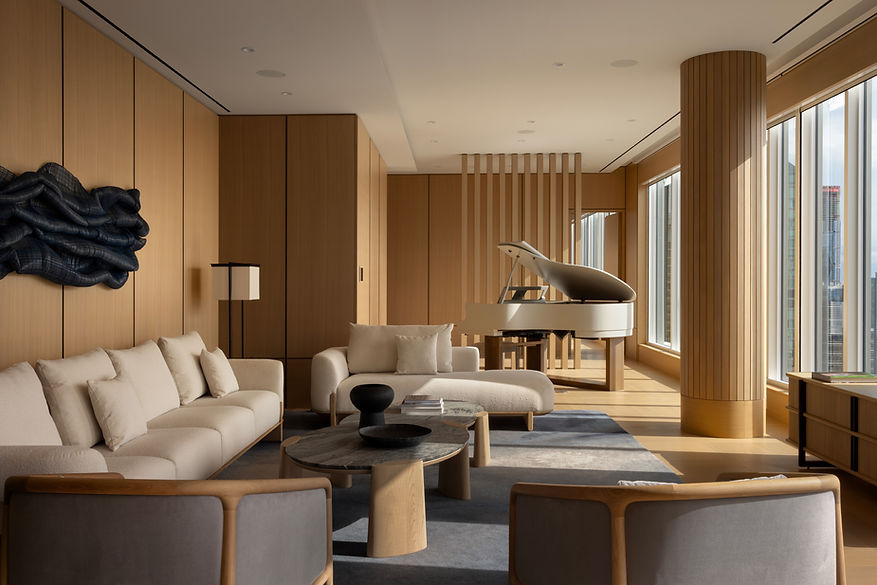
The interiors avoid overt references to Japanese design. Instead, the influence appears through proportion, rhythm, and restraint. Studio Munge approached the project less as a luxury hotel and more as a residential retreat in the sky — somewhere removed from the pace of the city below.
That sense of calm begins on arrival. Canadian landscape references are quietly woven together with details inspired by Japanese metal craftsmanship, particularly the layered forging techniques traditionally used in blades. Rather than translating these references literally, the design abstracts them into textures, surfaces, and spatial transitions. A bespoke work by Toronto-based artist Dennis Lin anchors the entrance sequence, reinforcing the project’s connection to the city’s creative scene.
THE SOAKING TUB AS A RITUAL OF RESTORATION
The guestrooms continue the hotel’s restrained atmosphere. Soft blue tones drawn from sky and water establish a subdued mood throughout, while layouts prioritise openness, views, and ease of movement. Nearly every room includes a walk-in wardrobe and generous living area, with soaking tubs positioned beside windows overlooking the city.
The wooden soaking tub — a defining element across Nobu Hotels — becomes central here too. Rooted in Japanese bathing culture, where bathing is treated as a restorative ritual rather than routine, it reinforces the hotel’s slower rhythm. The city remains present throughout, though carefully framed so it never overwhelms the sense of retreat.


MATERIAL RESTRAINT
Material consistency shapes much of the hotel’s atmosphere. The restrained palette focuses on tonal continuity and texture, with Tundra Grey stone from Turkiye used throughout floors, walls, bathrooms, and millwork. Finished with a leathered texture, it introduces tactility without visual heaviness.
Rift-cut white oak adds warmth and structure across wall panelling, screens, and custom furniture, while indigo-dyed textiles, carved wood details, and handcrafted Kawara tiles introduce quieter layers of craftsmanship. In the public areas, a bronze chainmail chandelier — designed to evoke the drape of a folded kimono — provides one of the few deliberately dramatic moments within an otherwise measured interior landscape.
Set across levels 41 to 45 with just 36 guestrooms, Nobu Hotel Toronto favours calm over spectacle — a quieter presence above the city.


