June 10, 2026 | DESIGN & INTERIORS
COLLAGE of ARCHITECTURAL MEMORIES
RA!
words Onur Baştürk
photos Portrait I Oscar Hernandez
Haciende Wabi I Ariadna Polo
Casa LL I Mariana Achach
They value experimentation and unconventional ideas, and share a deep interest in storytelling and craft. Cinema and the arts are among their primary references. Yet their greatest source of inspiration is closer to home: living in Mexico City. “It is a city in constant transformation,” they say, “one that resolves its challenges with creativity”. Meet RA!, the Mexico City–based architecture studio founded by Cristóbal Ramírez de Aguilar, Pedro Ramírez de Aguilar and Santiago Sierra — three architects with different backgrounds, educations and interests, brought together by a shared curiosity about how space can be felt as much as it is built.


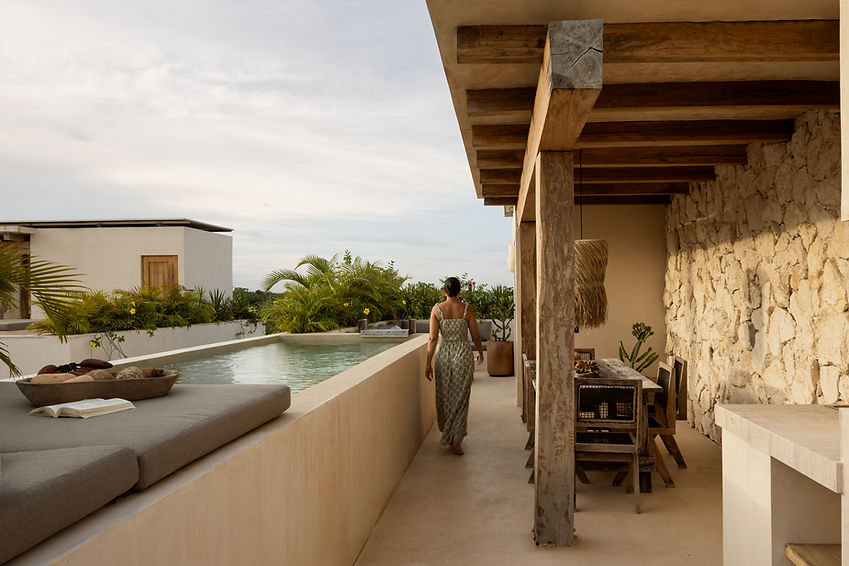
Haciende Wabi
WE SEE OURSELVES AS COLLECTORS OF LIVED MEMORIES
Could you share the founding story of RA!? How has the studio’s identity evolved over time?
RA! is an architecture practice founded in 2017 in Mexico City by Santiago Sierra, Pedro Ramírez de Aguilar and Cristóbal Ramírez de Aguilar. Our studio began working on competitions and residential refurbishments during a moment of profound transformation in Mexico. The year we were founded, Mexico City was struck by a major earthquake. Soon after came political change and a global pandemic. These events shaped the way we think about and practice architecture.
Today, Mexico is experiencing a vibrant cultural resurgence that continually informs our identity. At the same time, technological evolution has redefined the architectural profession. As a generation that transitioned from analog tools to digital processes, we move naturally between both worlds. For us, technology, culture and narrative are not external layers; they are essential to how we build ideas and imagine architecture.
You often suggest that space emerges not only from form but from memory and bodily experience. How does this idea translate into your design process?
In school we were taught that ancient architecture was rooted in composition and geometry. Historically, architecture has pursued perfection through proportion, rhythm and order. Modernism later introduced functionalism as a generator of form, and more recently buildings have often been conceived as objects, with their programmatic relationship to the user taking precedence. These approaches remain relevant to our practice. Yet we continue to ask what happened to human perception. Why do we still design primarily through floor plans, elevations and isometric drawings?
We believe architecture should be conceived through perspective, placing the human at the centre of the design process. We aim to design from experience rather than solely from intellectual principles. We see ourselves as collectors of lived memories, translating accumulated desire into space.
WE VALUE DIVERSE AND UNCONVENTIONAL IDEAS
Where does a project’s story usually begin — in the site, the client, or your own imagination?
These narratives emerge from a collection of memories and experiences that once moved our senses. That impulse is embedded in the name of our studio, RA!. For us, RA! is an exclamation of emotion and excitement — a gesture we seek to imprint into every project.
Inspiration often begins the moment clients start describing their vision. Whether it is a house in the mountains, a restaurant in the city or a hotel by the sea, their words trigger blurred images in our minds. We hold on to those first intuitions, allowing them to mature through research and careful engagement with the site. Gradually, the image becomes sharper.
Your work touches architecture as well as film, art and publishing. How do these disciplines expand your architectural thinking?
During a lecture, someone once described us as a collage. We are architects with different backgrounds, formations and interests, yet we find ways to create architecture collectively.
We value diverse and unconventional ideas. Film and the arts are among our primary sources of inspiration, as we are deeply drawn to storytelling and craft. We are especially curious about how filmmakers construct scenes through collaboration. Lighting, sound and cinematography create rhythm, tension and release. These emotional dynamics can also be orchestrated through architecture: a long hallway with a thin line of light at the end, a low ceiling that compresses the body, or a panoramic view that suddenly opens the horizon. These are the elements we use to build atmosphere and tell stories through space.
After the pandemic, we extended this collaborative spirit into publishing. We created a book in partnership with an independent editorial platform and invited thirty Mexican architects to participate. The initiative aimed to rebuild relationships and open new conversations within the architectural community. Conceived as a diary, the book allowed each practice to freely document daily processes and reflections, creating a collective portrait of a moment in time.


Casa LL
EXPERIMENTATION IS THE FUEL OF OUR PRACTICE
What role does experimentation play in your practice? Is risk-taking essential to your creative process?
Experimentation is the fuel of our practice. We understand architecture through four categories. The first three are rooted in emotion and human relationships: personal, interpersonal and societal, as reflected on our website. The fourth is experimentation.
This category allows us to work with fewer restrictions and question the boundaries of what is traditionally defined as architecture. It becomes a space of freedom where ideas can be tested without the immediate pressures of function or convention. Experimentation operates as an internal laboratory, expanding our methods and refining how we approach new projects.
MEXICAN ARCHITECTURE DEEPLY INFORMS OUR DESIGN APPROACH
What nourishes your imagination? Are there particular influences that consistently feed into your work?
Cinema and art are significant influences, but so is observing cities and people through travel and daily life in Mexico City. We see Mexico City as a place in constant transformation — a city that continually reinvents itself and resolves challenges with creativity. Its energy and density keep us alert and curious. Travel broadens that awareness. It helps us understand different ways of living. As architects, we feel responsible for observing how people eat, sleep, bathe, gather and move through their routines.
How do you see the relationship between contemporary Mexican architecture and local traditions?
Globalisation has contributed to a growing standardisation of the built environment, leading many places into a subtle crisis of identity and a gradual erosion of local values. As Mexican architects, we are highly conscious of this. Our heritage is layered and deeply rooted in craft and tradition, which is why we prioritise preserving and interpreting the character of each context we build in, whether in Mexico or abroad. We are fortunate to work with skilled construction workers and artisans who keep traditional techniques and materials alive. Collaborating with them reinforces one of our core principles: creating value through local knowledge and craftsmanship.
How does Mexican culture shape your design approach?
Mexican architecture deeply informs our design approach, as many of our formative spatial experiences are rooted in its emotional and cultural landscapes. From prehispanic sites where scale and territory become inseparable, to colonial schools defined by luminous patios. From modern houses with introspective gardens to colourful haciendas and contemporary works of monumental presence.
These layered encounters shape how we think about space. Rather than a single lineage, we see our practice as a collage of influences — a continuous layering of architectural memories.
How do you see Mexican architecture evolving in the coming years? Where would you like RA! to position itself?
We see Mexican architecture developing with a growing awareness of its relationship to the land on which it is built. There is greater consciousness about reducing unnecessary space and making decisions grounded in the fundamentals of living. Within this context, we see our practice evolving through new typologies and diverse settings, constantly formulating new questions. Remaining in a state of curiosity is not a strategy but a condition that allows us to keep learning and refining our approach.


