October 13, 2026 | TRAVEL
VILLA PAULI:
A NEW CHAPTER
words Maria Chiara Antonini
photos Hannes Söderlund
There is a particular pleasure in staying in a historic villa surrounded by a garden, with the deep blue waters of the Swedish archipelago stretching beyond it. At Villa Pauli, in Djursholm, just outside central Stockholm, that sense of retreat is closely tied to the history of the house itself.


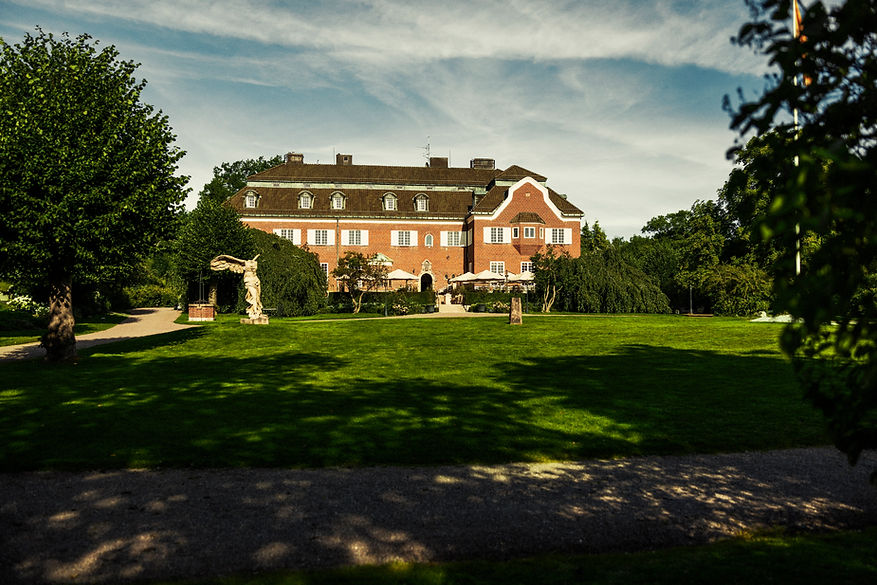
Villa Pauli has more than a century of history behind it. The family who commissioned it was among the most prominent and influential figures in Sweden’s economic and financial life. The year 1906, engraved in the stone portal framing the wooden entrance door that leads from the park into the villa, marks the beginning of its construction, which was completed in 1907.
The name Villa Pauli is a tribute to Anna Pauli, daughter of Johan Wilhelm Smitt, one of Sweden’s wealthiest men in the 19th century. Smitt made his fortune in Latin America during the 1850s, co-founded Enskilda Bank and founded Handelsbanken. The villa was designed by architect Ragnar Östberg and adorned with works by painter Georg Pauli and sculptor Carl Eldh. More than a century later, many of its original details remain intact. The wood panelling of the entrance and grand ground-floor hall, the frescoes in the principal drawing room and the large stone fireplaces throughout the villa all contribute to its distinctive character.
Villa Pauli remained a private residence until 1968 and became a private members’ club in 1986. Today, the property is entering a new chapter in its history, opening its doors to guests looking for a more intimate way to experience Stockholm. The first phase of the transformation introduced a new wing with an oceanfront restaurant, wellness club, poolside spaces, rooftop terraces, a tennis court and additional hospitality areas.
A CONTEMPORARY LAYER
The architectural vision for the addition was led by architect Jonas Glock, whose approach centred on what he describes as “a contemporary layer in time” within one of Djursholm’s most historically significant estates.
“Historic buildings should never become frozen in time,” Glock explains. “The ambition of this new project was to add something unmistakably contemporary while allowing the original villa to remain the emotional and architectural heart of the estate. The new spaces are designed as a reflection of our own time, carefully added onto the existing story.”
The result is deliberately understated from a distance. The expansion preserves the visual integrity of the surrounding park while allowing the estate to evolve without competing with the original villa. Large glass façades, restored stone elements, handcrafted brickwork and reinterpreted historical materials establish a measured relationship between old and new.
The second phase of the project focuses more directly on hospitality, with additional rooms and three suites now available to guests who are not members of the club.


BEYOND SCANDINAVIAN MINIMALISM
The interiors, created by SPIK Studios under the creative direction of Nina Glendinning, deliberately move beyond the restrained language of Scandinavian minimalism. Instead, they embrace a richer and more expressive aesthetic: jewel-toned velvets, dark-stained oak, limestone floors, brass details, hand-painted murals, mirrored surfaces, vintage references and contemporary artworks come together in an eclectic but carefully balanced composition.
Throughout the villa, tactile materials and handcrafted details encourage a slower reading of the spaces. Rather than pursuing a predictable interpretation of luxury, the intention was to create interiors that feel intimate and slightly unexpected, with details that reveal themselves gradually.
“We wanted the spaces to feel immersive and emotionally charged,” says Glendinning. “There are hidden references throughout — in the textiles, the artwork, even in the shapes of the furniture. It should feel personal and atmospheric, never anonymous.”
A NEW RHYTHM
At the heart of the new addition is St. Nobl, Villa Pauli’s restaurant. Conceived as a natural extension of the historic villa, it unfolds across a series of interconnected spaces, from an indoor atrium and bar to terraces and poolside dining areas. Velvet, marble, Murano glass chandeliers, mirrored surfaces and richly textured fabrics continue the material language found elsewhere in the new interiors.
Beyond the spa, gym and tennis courts, one of Villa Pauli’s more unusual additions is the sauna boat: a small private motorised sauna that heads out onto the water, offering a different perspective on the Swedish archipelago.
At Villa Pauli, the original architecture remains the point of departure, while the new interventions introduce another layer rather than attempting to recreate the past. The result is a place where history, architecture, hospitality and contemporary design continue to evolve together.


